Richard Williams
Wolf HallRichard Williams is Thomas Cromwell’s nephew, the son of Kat Cromwell and Morgan Williams, and later known as Richard Cromwell. His recurring presence connects Cromwell’s ambitions at court to the family and dependants he regards as a possible legacy beyond his own son Gregory.
Identity and Family
Richard appears in the opening cast as Kat and Morgan’s son. Cromwell’s return to England after more than twelve years abroad is bound up with a desire to see his sisters and learn who has died and who has been born. The family ties he renews include the connection to Richard, whose place in the household becomes more than a matter of kinship.
Cromwell describes Richard as sharp, keen, and forward, contrasting him with Gregory’s gentler temperament. He also recognizes promise in Christopher, the son of his sister Bet, and trusts Rafe Sadler as he would a son. This broad circle of young men becomes, in Cromwell’s view, a beginning of dynastic continuity, though he explicitly distinguishes it from a true dynasty.
Place in Cromwell’s Household
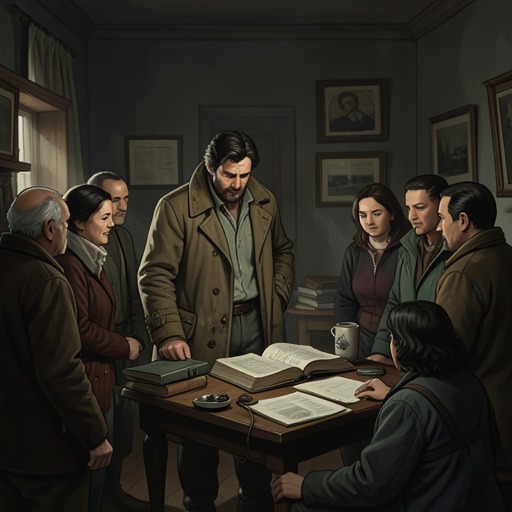
Richard belongs to the extended family that gathers around Cromwell. At a family occasion, he is among the boys who withdraw to a corner while the adults talk, alongside his cousin Walter and Bet’s sons Christopher and Will. Their private conversation turns to the name Walter, a reminder of the dead father whom Cromwell is glad no longer to face. The scene places Richard within a family shaped both by affection and by the lingering harm of an earlier generation.
Cromwell’s care for Richard also takes practical form. In 1534, as Thomas More is to be moved to the Tower, Cromwell writes a note directing Richard to present himself to the Abbot of Westminster and escort the prisoner. The instruction assigns him a role in the handling of a politically consequential prisoner, bringing the nephew into the machinery of Cromwell’s public responsibilities.
Political World and Narrative Significance
Richard is not given an independent political programme in the available scenes; his importance lies in how Cromwell draws family into the structures of service and responsibility. His assignment to escort More places him near a confrontation between parliamentary authority and religious conscience, while showing how Cromwell’s household can supply agents for the work of government.
The contrast between Richard and Gregory also clarifies Cromwell’s understanding of inheritance. He fears passing the knowledge gained through hardship to his own son, yet sees capable younger men around him as a fragile beginning. Richard therefore represents both kinship and possibility: a nephew whom Cromwell helps to raise into the world, and part of a wider, chosen network through which his influence might continue.